
Every year across global engineering institutions, an unspoken rule dominates the student mindset: secure a near-perfect Cumulative Grade Point Average (CGPA) to unlock an elite career trajectory. For generations, this numerical metric acted as an absolute gatekeeper, dictating who received access to premium placement slots and which resumes were fast-tracked by corporate recruiters.
However, a quiet structural revolution has swept through the modern technology sector. As software architecture transitions toward decentralized cloud networks, distributed systems, and highly complex artificial intelligence pipelines, the traditional correlation between classroom test scores and real-world engineering competency has collapsed.
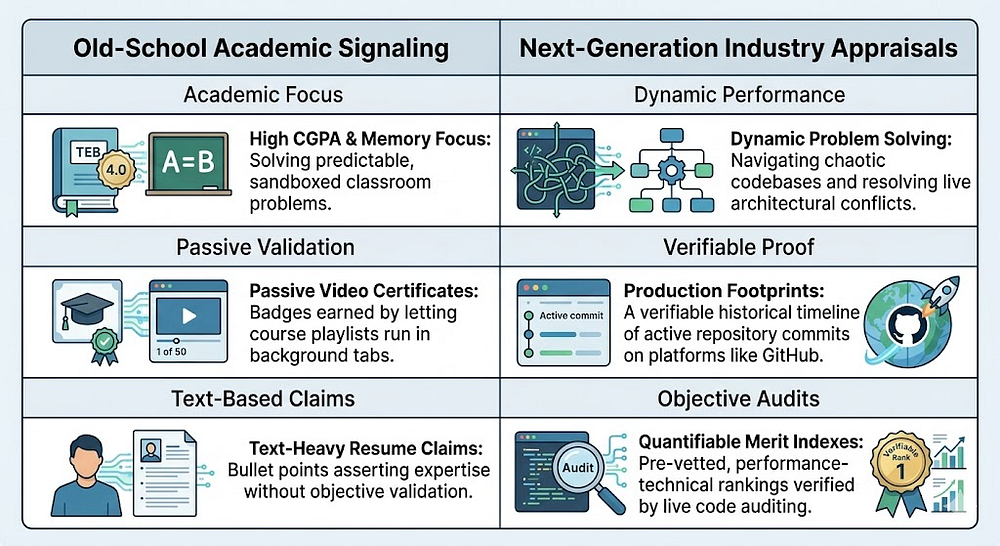
Today, a high grade point average simply proves a student’s capacity to navigate a structured, predictable academic curriculum. It does not measure their capability to debug a production environment under load, refactor a convoluted legacy codebase, or architect a scalable system from the ground up. In a hyper-automated talent marketplace, relying entirely on academic marks is becoming a high-risk strategy for both ambitious students and growth-oriented hiring teams.
The Genesis of the Academic Disconnect
To understand why the signaling power of academic performance has degraded, one must dissect the structural limitations of the traditional university evaluation model. Standard university syllabi are inherently static, frequently taking multiple semesters or even years to update core theoretical frameworks. Examinations are predominantly configured to reward rote memorization, syntax reproduction, and the resolution of sandboxed problems that contain single, predictable right answers.
In contrast, the global technology sector moves at an exponential velocity. A student can spend weeks memorizing the precise mathematical definitions of database normalization to score a perfect mark on a terminal exam, yet remain completely incapable of handling real-world data mutations, implementing robust caching layers, or securing distributed API endpoints against malicious traffic.
When a corporate engineering lead evaluates a junior applicant, they are not looking for a human encyclopedia who can recite standard algorithmic definitions. They are searching for an execution-focused builder who understands how systems fail, how data mutates across network boundaries, and how to write maintainable, well-documented code within a shared development lifecycle.
Diagnosing the Two Core Mismatches in Modern Sourcing
The reliance on academic performance as a primary indicator of professional potential introduces two distinct points of failure into the modern hiring ecosystem:
The Artificial Screening Bottleneck
Historically, talent acquisition teams used high cutoffs as a crude, blunt-force mechanism to manage the overwhelming volume of incoming entry-level applications. This approach assumed that a high score served as a reliable proxy for work ethic and intelligence.
However, this automated filtering mechanism creates an intense systemic bias. It frequently blocks exceptional self-taught engineers, open-source contributors, and product-focused builders from Tier-Two and Tier-Three institutions simply because their academic scores fell slightly below an arbitrary numerical threshold. This results in companies missing out on high-intent builders while interviewing individuals who look flawless on paper but possess zero practical implementation depth.
The Problem-Solving Asymmetry
Academic evaluation environments operate under zero-risk conditions. Students are given highly documented parameters, clean datasets, and linear requirements.
Corporate development floors, however, are fundamentally chaotic. Codebases are massive, documentation is frequently fragmented, and requirements shift continuously based on user feedback and market pressures. A student who has trained exclusively to pass structured classroom assessments is often paralyzed when confronted with an ambiguous, open-ended problem statement that requires navigating undocumented open-source libraries or resolving intricate dependency conflicts.
To thrive in the current market, the modern technical footprint must actively transition away from passive, static milestones toward active, objective proof of capability.
Systematically Re-Architecting Your Placement Strategy
If you are a student navigating a highly competitive technical environment, you must actively diversify your professional signaling layer. You cannot rely on an institutional transcript to serve as your singular career differentiator. You must execute a deliberate, multi-phase transformation:
1.Convert Knowledge into Open Assets:
Phase One.
Stop building sandboxed projects that exist solely on your local computer to fulfill a classroom assignment. Every piece of software you write must be completely version-controlled, pushed to public repositories, and deployed live using modern cloud-native infrastructures. If an outside engineering manager cannot review your codebase, your technical claims do not exist.
2.Engage with Live Open Source Systems:
Phase Two.
The most definitive way to prove your readiness for a professional software team is to build within one out in the open. Dive deep into established open-source projects, audit their active issue trackers, submit structured pull requests that conform to strict code styling guidelines, and actively participate in public code reviews. This documents a verifiable timeline of real engineering contribution.
3.Automate Your Competency Indexing:
Phase Three.
Bypass the broken, automated resume parsing systems by anchoring your portfolio to an advanced talent indexing engine. By connecting your active developer spaces straight to an analytical infrastructure that measures code quality and systemic depth, you remove the requirement of relying on an institutional grade point average to prove your competence.
Where Deftrank Dismantles the Pedigree Barrier
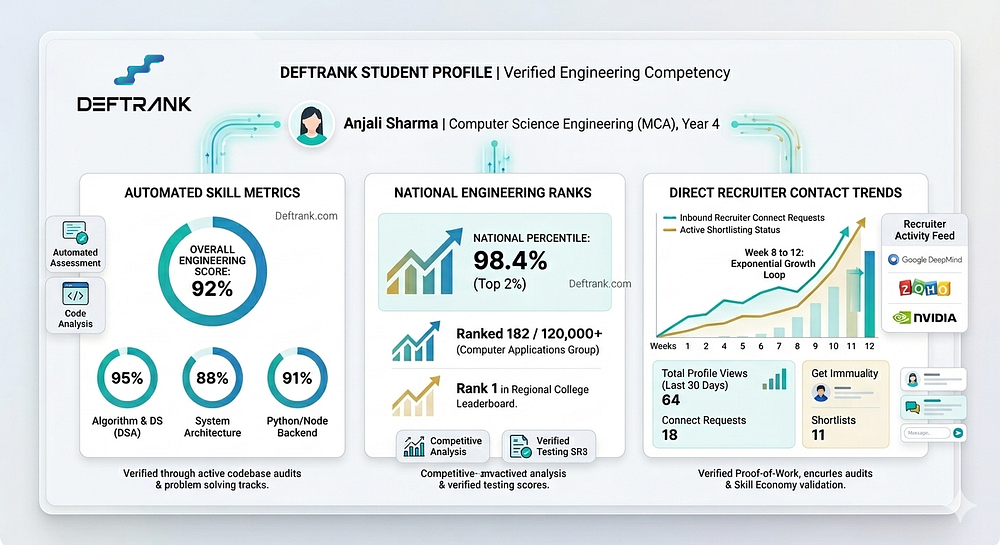
This fundamental shift from text-based claims to verifiable evidence is precisely why Deftrank is reorganizing how technical talent is identified, validated, and directly connected to placements. Deftrank operates as a next-generation, AI-driven verification infrastructure constructed to eliminate grading inflation and institutional bias from the talent acquisition workflow.
Instead of demanding that a student compile a traditional text-heavy resume or rely on a static college grade point average, Deftrank hooks directly into a builder’s live developer ecosystem. The platform’s advanced analytical engine deep-dives into your public repositories, auditing code cleanliness, analyzing architectural optimization, evaluating database design patterns, and scoring structural problem-solving consistency.
For a student trying to stand out in a crowded market, this completely flips the dynamics of the job hunt. Your actual execution depth is transformed into a clear, un-fakeable technical ranking that premium product teams search, filter, and source directly. By giving corporate recruiters an objective index of real-world capability, Deftrank entirely bypasses the traditional resume filtering layer — ensuring that high-growth internships and placement opportunities are unlocked exclusively by your proven ability to build software that works.
Frequently Asked Questions (FAQs)
Does this mean maintaining a high college score is completely irrelevant?
Not at all. Academic diligence demonstrates discipline, structured focus, and a strong grasp of foundational theoretical computer science concepts. However, your score is simply the baseline entry requirement; it is no longer the final differentiator. Your public proof of work is what turns that academic foundation into a formal job offer.
How can a student with a moderate grade point average compete with a top-ranked academic peer?
Through visible, verifiable execution. A student with a modest score who has built scalable microservices, launched functional applications, or contributed extensively to complex open-source infrastructures will consistently out-value a top academic performer who possesses zero public proof of work. Tech teams choose engineers who can ship production code over individuals who excel at taking exams.
The Final Conclusion
The era of using an abstract numerical score to serve as an absolute career shield is officially over. In a global market that values continuous deployment, clean architecture, and rapid implementation, your public code must speak louder than your transcript.
Stop trying to convince recruiters that you are qualified based on your grade point average. Focus on building your public ecosystem, commit your code transparently, index your capabilities through verified merit pools, and let your execution open the gates to your technical career.
[Connect your development environments, verify your engineering depth, and secure your ranked Deftrank profile today.]