
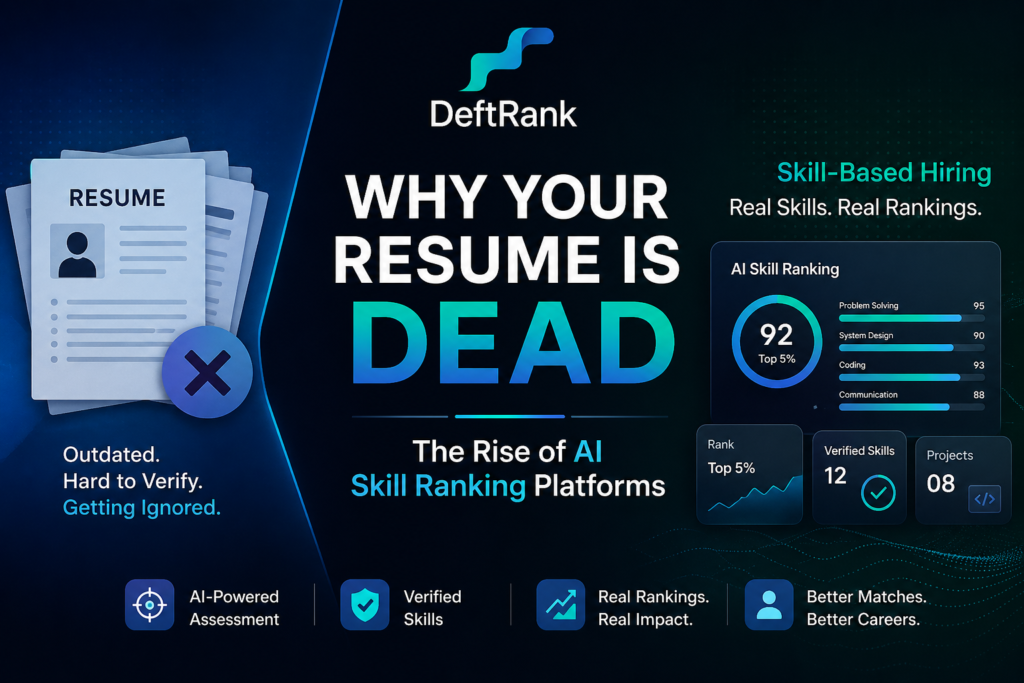
The uncomfortable truth: resumes don’t work anymore
For decades, resumes have been the standard way to showcase experience. A neat PDF, a list of skills, some bullet points — and hope.
But here’s the reality:
Hiring has changed. Radically.
Recruiters don’t have the time to read 300 resumes.
Most applications never even reach human eyes.
And worse — resumes are easy to manipulate.
Anyone can write:
- “Expert in React”
- “5+ years of experience”
- “Led multiple successful projects”
But what does that actually mean?
Today, companies don’t just want claims.
They want proof.
The real problem with resumes
Let’s break it down simply.
A resume is:
- Static
- Self-reported
- Hard to verify
- Often exaggerated
From a hiring perspective, it creates more questions than answers:
- How strong is this candidate actually?
- Can they solve real-world problems?
- How do they compare to others?
This is exactly why the hiring process has become longer, more expensive, and inefficient.
Enter AI-powered skill ranking
This is where platforms like DeftRank are changing the game.
Instead of asking “What do you say you can do?”,
they ask:
“What can you actually demonstrate?”
AI-based skill ranking platforms evaluate candidates using:
- Real-world problem-solving tasks
- Standardized skill assessments
- Behavioral and logical analysis
- Performance benchmarking against other candidates
The result?
A data-backed skill profile, not just a written claim.
From resume to reputation
We’re moving from paper-based hiring to performance-based hiring.
Think about it like this:
- A resume is your opinion about yourself
- A skill ranking is the market’s opinion about you
That’s a big shift.
Instead of saying:
“I’m a senior developer”
You can now show:
“I rank in the top 10% for backend performance and system design”
That’s far more powerful — and far more trustworthy.
Why companies are adopting this fast
There’s a strong reason why this shift is accelerating.
AI skill ranking platforms help companies:
1. Hire faster
No need to manually screen hundreds of resumes.
2. Reduce bad hires
Decisions are based on real performance, not assumptions.
3. Compare candidates objectively
Everyone is measured on the same scale.
4. Focus on capability, not keywords
No more keyword-stuffing resumes just to pass filters.
What this means for professionals
If you’re a developer, designer, marketer, or any knowledge worker — this shift affects you directly.
The market is moving toward:
- Proof of work over claims
- Demonstrated skills over listed skills
- Continuous evaluation over one-time applications
So the question is no longer:
“How good does your resume look?”
It’s:
“How do you perform when it matters?”
Is the resume completely dead?
Not entirely — but it’s losing relevance fast.
Resumes may still exist as a summary,
but they are no longer the deciding factor.
They are becoming:
- A supporting document
- Not the decision-maker
The real decision is shifting toward:
- Skill scores
- Performance insights
- AI-driven comparisons
The future of hiring is already here
We’re entering a world where:
- Your skills are continuously evaluated
- Your ranking evolves over time
- Your opportunities match your actual capability
Platforms like DeftRank are not just tools —
they represent a shift in how talent is discovered and trusted.
Final thoughts
This change might feel uncomfortable at first.
But it’s actually fairer.
Because in this new system:
- You don’t need perfect wording
- You don’t need “resume tricks”
- You don’t need to impress on paper
You just need to be good at what you do.
And finally — that’s what gets rewarded.