
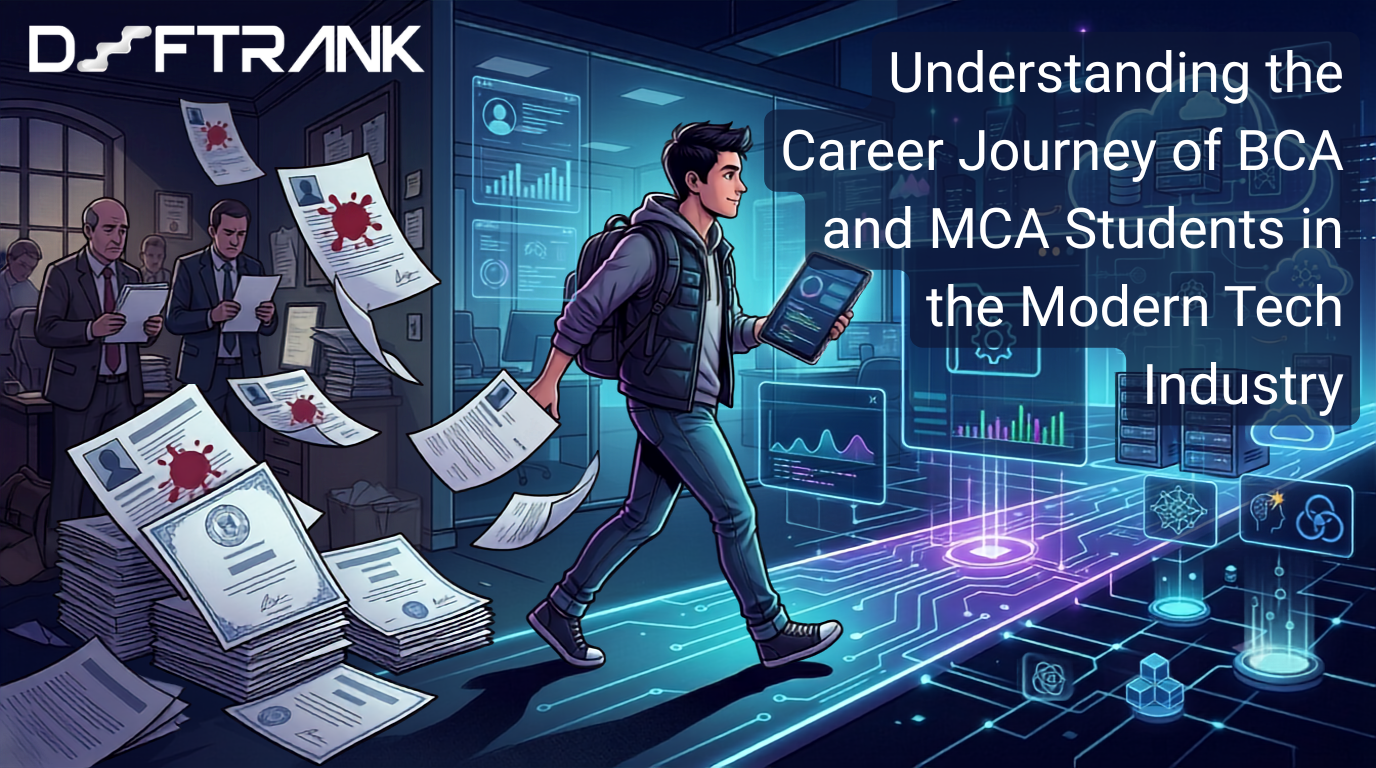
The pathway into the global software ecosystem has undergone a massive paradigm shift. For a long time, standard industry hiring pipelines operated under a rigid preconception that a traditional four-year engineering degree was the singular gateway to high-growth development roles.
This legacy filter created an unnatural systemic barrier for students pursuing a Bachelor of Computer Applications (BCA) or a Master of Computer Applications (MCA).
Today, the modern tech landscape is experiencing a structural reorganization. As software complexity scales and computational workloads shift toward multi-platform deployments, artificial intelligence, and cloud-native frameworks, corporate teams are experiencing a profound realization. The market no longer has the luxury of evaluating talent based on institutional titles or the specific length of an academic program. Instead, hiring architectures are prioritizing demonstrable execution capability over classroom seat-time. For BCA and MCA aspirants, this evolution represents an unprecedented democratization of opportunity — but only for those who understand how to translate their academic timeline into verifiable proof of skill.
Diagnosing the Two Core Bottlenecks in Entry-Level Sourcing
While the industry’s willingness to hire computer application graduates has scaled exponentially, two profound bottlenecks prevent brilliant self-taught builders from reaching high-tier development environments:
1. The Legacy Screening Automation Filter
When a product-focused organization posts an entry-level development role on global job boards, they are instantly inundated with thousands of identical resumes. To manage this operational deluge, talent teams deploy Automated Tracking Systems (ATS) configured with blunt, legacy filters. These automated systems are frequently programmed to prioritize specific traditional degree nomenclature, meaning an exceptional BCA student’s resume is often rejected by an algorithmic parser before a human engineering lead ever reviews their portfolio.
2. The Credibility Gap and Risk Asymmetry
When an engineering manager looks at a junior profile, they are managing hiring risk. They understand that anyone can use generative AI models to write boilerplate code, paste clean-looking functions onto a static document, or claim expertise in a modern frontend framework. Because standard computer application programs are often perceived as less structurally standardized across regional universities, the recruiter bears a high cognitive load to verify if the applicant truly understands system architecture or if they simply memorized a basic tutorial playlist.
How the Modern Technical Architecture Validates Talent
In a mature technology environment, technical competence is verified by examining an applicant’s public digital footprint. Companies looking for high-intent builders do not rely on self-reported resume bullet points; they look for active, historical proof of work across the open internet.
For an MCA student aiming for premium product engineering roles, your public repositories act as your real-world transcript. A hiring team would infinitely rather read a sequence of structured pull requests showing how you refactored an asynchronous database connection than scroll through a pristine list of classroom exam marks.
Systematically Accelerating Your Trajectory
If you are a student navigating a computer application program outside of a high-profile metropolitan hub, you cannot rely on inbound campus placement drives to secure your target role. You must execute a deliberate, multi-phase off-campus positioning strategy:
Establish Your Digital Workspace
Stop building sandboxed applications that live exclusively on your local machine. Every project, tool, or utility you construct must be completely documented, pushed to a public repository, and deployed live using accessible hosting infrastructures. If your code cannot be audited by a third party, it effectively does not exist.
Contribute to Shared Open Source Networks
The best way to prove you can function within a corporate engineering team is to contribute to real software platforms out in the open. Dive into active open-source projects, locate open issue logs, write code that adheres to established style guidelines, and engage in public code reviews. This builds an indisputable timeline of professional execution.
Index Your Code Performance Automatically
Bypass manual application portals by using advanced talent indexing engines. By integrating your active development environments directly into a verification layer that translates raw code into dynamic competency scores, you remove the necessity of relying on institutional degree tags to validate your worth.
Where Deftrank Rewrites the Rules for Application Students
This foundational shift from text-based claims to verifiable evidence is precisely why Deftrank is transforming how technical talent is discovered, ranked, and onboarded. Deftrank functions as an advanced, AI-driven verification infrastructure designed to eliminate institutional pedigree bias entirely from the tech industry.
Instead of demanding that a student compile a traditional text-heavy resume or navigate broken automated screening filters, Deftrank hooks directly into a builder’s live developer ecosystem. The platform’s analytical engine reviews your public code, evaluates the structural soundness of your database schemas, tracks your architectural decision-making patterns, and measures your algorithmic consistency.
For a BCA or MCA student, this completely alters the dynamics of the job hunt. Your hard-earned building skills are converted into an objective, un-fakeable technical ranking that top-tier recruiters search and filter directly. By providing corporate teams with a pre-vetted index of execution depth, Deftrank systematically dismantles the legacy screening mechanisms that historically blocked computer application students — opening direct pathways to premier internships and software engineering placements based solely on your proven capacity to build.
Frequently Asked Questions (FAQs)
Absolutely. After your initial engineering onboarding phase, the tech industry operates as a pure skill economy. Corporate engineering reviews care exclusively about system scaling reliability, code optimization, and architectural execution. Once you demonstrate those capabilities on production systems, academic program duration ceases to be a factor.
If a BCA graduate possesses deep, verified proof of work and strong practical portfolios, entering the market early allows them to build real-world experience that frequently out-values an additional multi-year academic degree. If you choose to enter the workforce, you can continuously validate your evolving technical depth through active development spaces and live indexing platforms.
The Ultimate Conclusion
The era of relying on an institutional degree tag to serve as a lifelong career shield is coming to a close. In a technical market that demands continuous execution, adaptive tool usage, and real-world system building, your work must speak louder than your academic title.
Stop trying to convince legacy corporate systems that your degree program is valid. Build your ecosystem, commit your code openly, verify your capabilities through objective merit pools, and let your active execution open the gates to your technical career.