
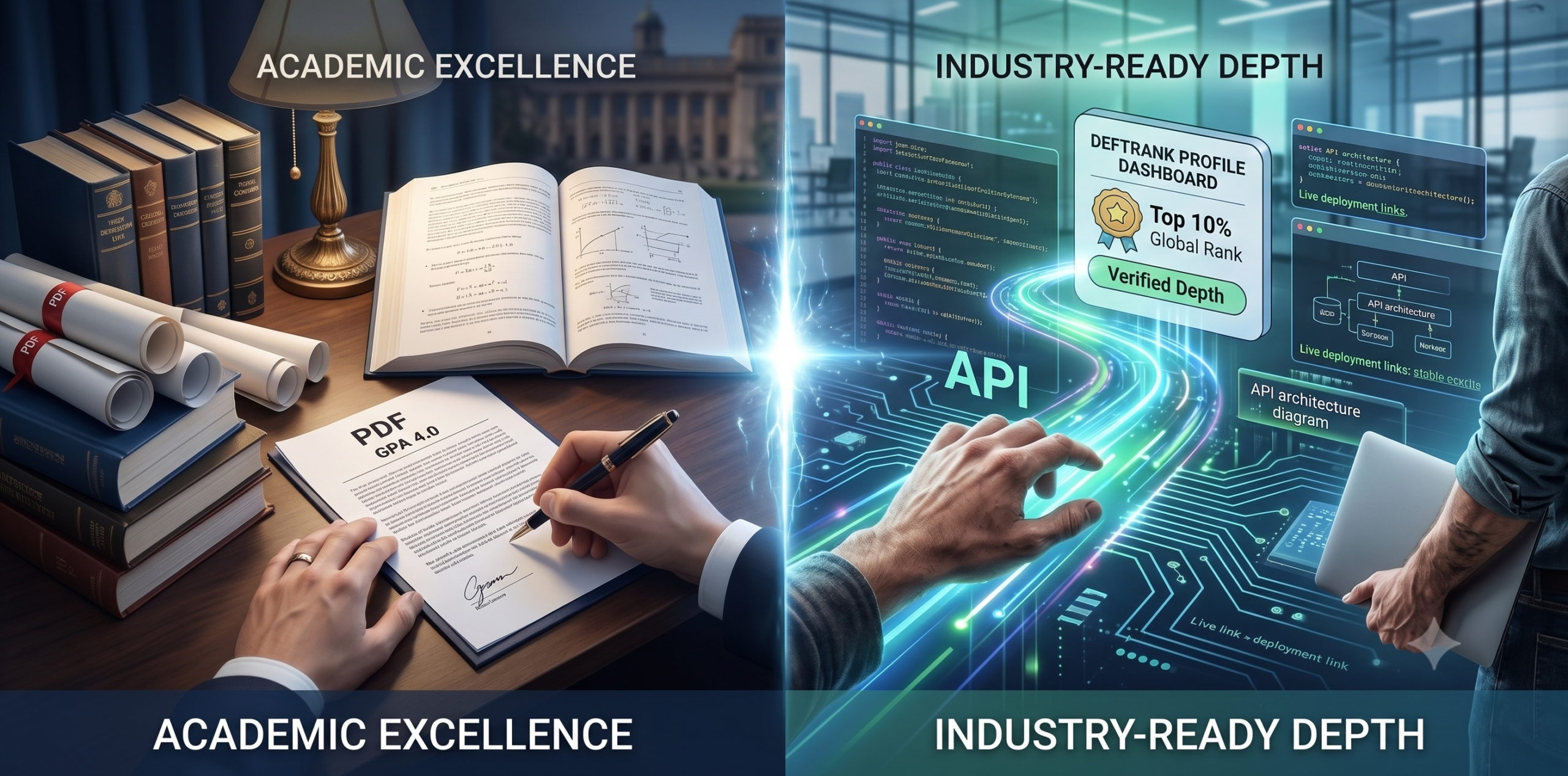
Every year during placement season, a familiar scene plays out across college campuses. High-achieving students with flawless academic records sit across from industry interviewers, confident that their credentials guarantee success—only to meet a sobering reality.
In an era driven by automation and rapid digital transformation, traditional metrics used to measure a student’s potential are breaking down. The gap between classroom performance and actual engineering readiness has widened into a chasm—and the traditional paper resume is no longer enough to cross it.
1. The Reality of the Modern Engineering Landscape
For decades, the standard playbook for an engineering student was clear: maintain a high CGPA, attend every lecture, memorize the prescribed syllabus, and secure a generic completion certificate during the summer. This approach assumed that academic discipline directly translated to engineering capability.
In today’s market, that assumption is dead. With generative AI tools capable of writing boilerplate code and passing standardized multiple-choice tests, a high GPA or a passive video-course certificate no longer signals true competence to a hiring manager. The industry is experiencing an unprecedented surge in applicant volume, yet talent acquisition teams consistently report that they cannot find candidates capable of building real, production-ready software.
2. Diagnosing the Core Disconnect
The root of the problem lies in what colleges measure versus what the industry actually rewards. The academic ecosystem is fundamentally structured around rote learning and static evaluations. Industry, on the other hand, operates in a state of continuous adaptation and real-world execution.
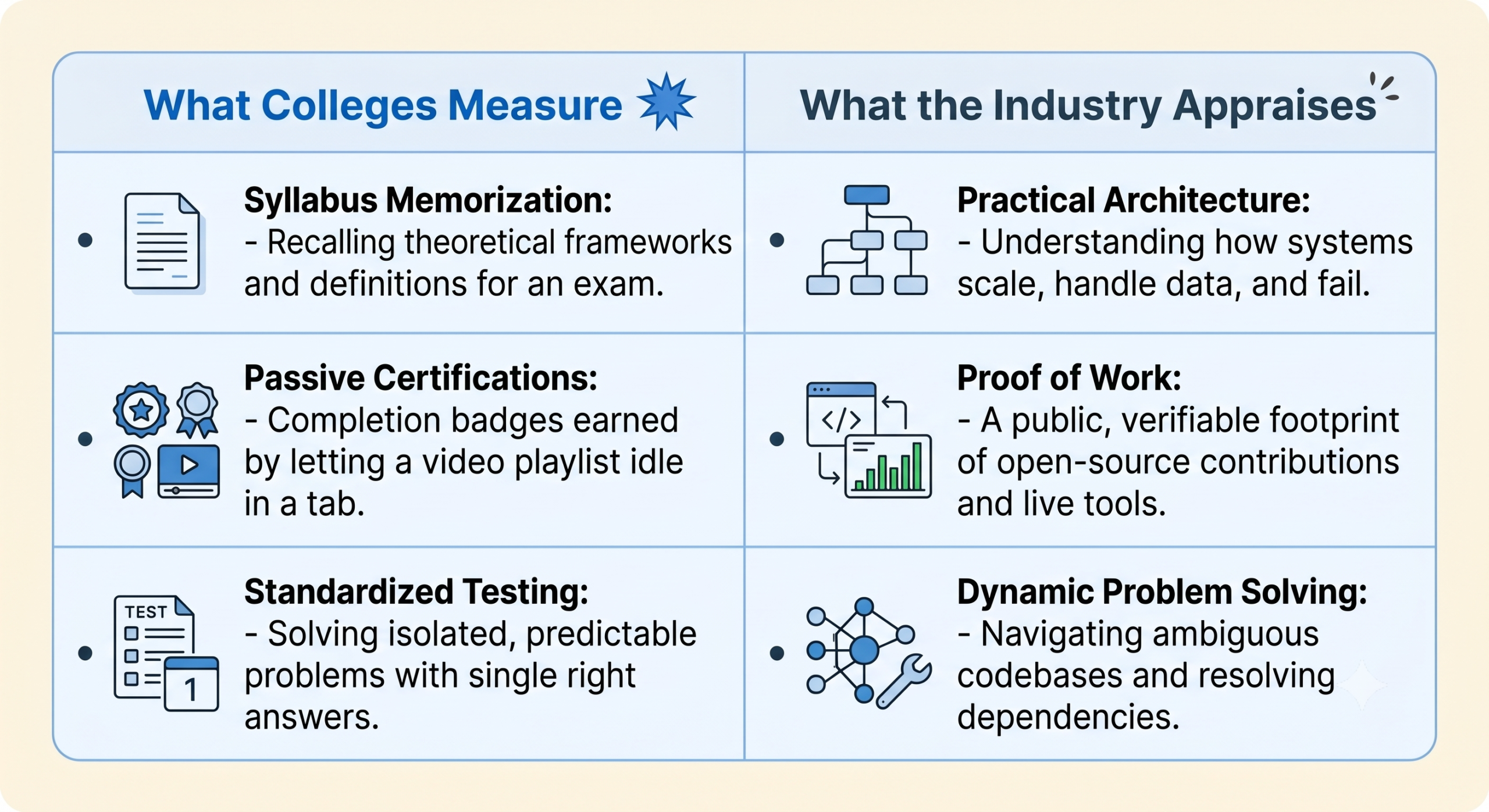
When a student’s entire profile is built on passive milestones, they struggle to clear the first practical round of a modern interview. They can define an API, but they cannot build, secure, or deploy one.
3. The Traditional Approach Has Failed
Because screening hundreds of identical junior resumes is an operational bottleneck, companies have traditionally resorted to lazy filters: shortlisting exclusively from Tier-1 institutions or setting arbitrary minimum CGPA cutoffs. This broken system creates a massive risk asymmetry:
⚠️ For Recruiters
They waste valuable time interviewing candidates who look spectacular on paper but cannot write clean, maintainable, production-ready code.
🛑 For Students
Exceptional, self-taught builders from Tier-2 and Tier-3 institutions get completely filtered out by automated ATS platforms before a human ever sees their work.
4. How Students Can Bridge the Gap
To stay competitive, students must change how they document their engineering journey. The transition from an academic mindset to an industry-ready mindset requires a deliberate, structured shift in strategy:
Stop collecting passive tutorials. Choose a real-world problem—even a small one—and build a functional application from scratch. Focus on clean code, proper state management, and edge-case handling.
Your GitHub commit history, system architecture diagrams, and live deployment links are your real resume. Document your design choices, technical hurdles, and exactly how you solved them.
Translate your raw repositories into structured, verifiable metrics. Instead of telling a recruiter you know a technology, let your public technical footprint prove your depth objectively.
5. Where DeftRank Fits into the Solution
This exact validation layer is why Deftrank is reorganizing how technical talent is discovered. Deftrank doesn’t care about the pedigree of your college or the formatting of your PDF resume. Instead, it serves as an AI-driven verification infrastructure that plugs directly into where your actual building happens.
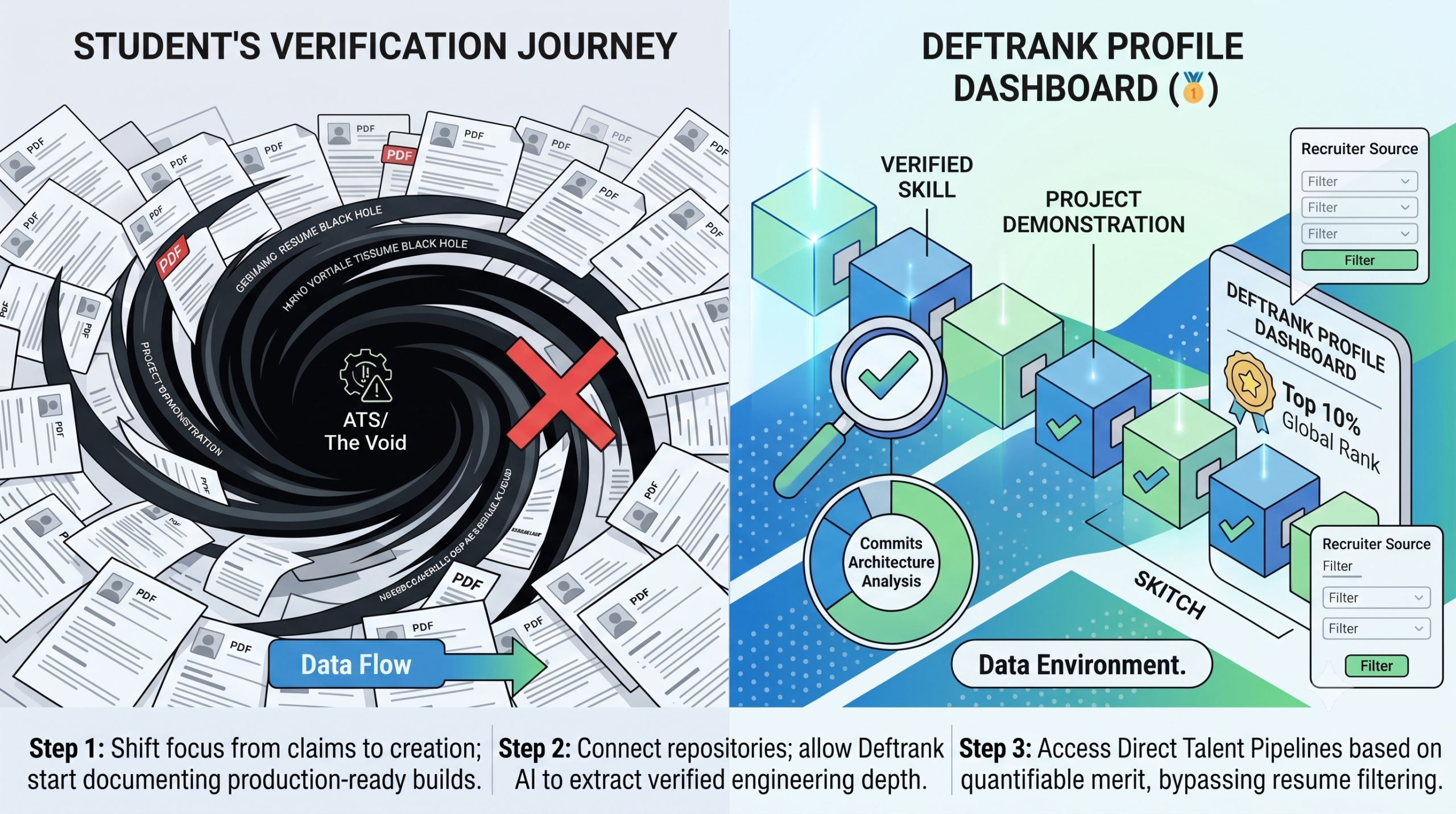
By analyzing your public code repositories, evaluating your architectural decisions, and tracking your practical problem-solving consistency, Deftrank builds an un-fakeable, merit-based talent index.
What this change means for the ecosystem:
6. Frequently Asked Questions (FAQs)
The Bottom Line
The resume era is over. In a highly automated and competitive market, claiming you have a skill on a piece of paper is a losing strategy. Your work has to speak for itself. Stop trying to convince recruiters you are ready for the industry. Build your footprint, verify your capabilities, and let your execution open the doors for you.